Drift scoring explained: chains, clean exits and penalties
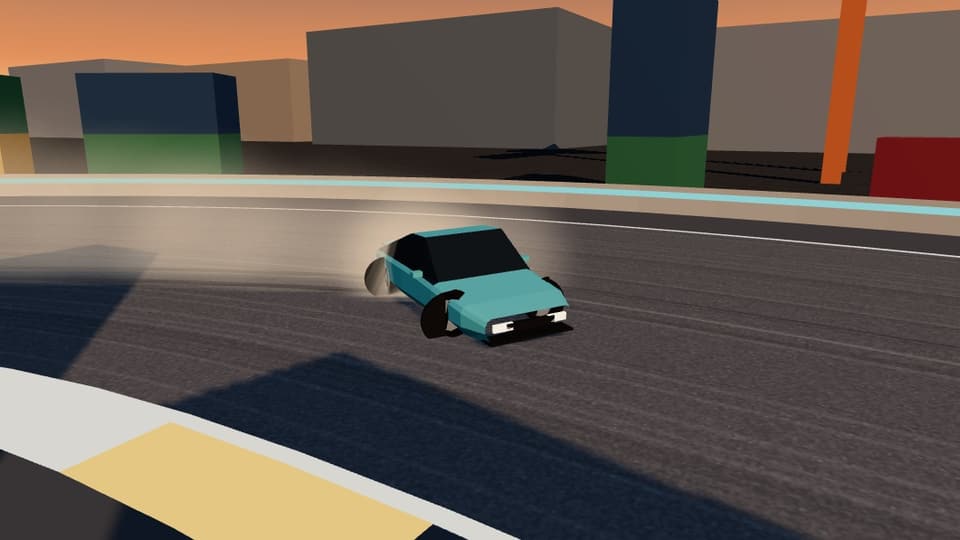
Slipline Garage scores a drift from four things: how fast you are going, how sideways the car is, how long you hold it, and whether you are on the road. Points build in a chain while you slide and are banked when you drive straight for 1.2 seconds. A wall hit, a spin, or leaving the road forfeits the chain.
Every number below is read from the same configuration the game itself uses, so this page cannot drift out of date quietly. Scoring version: 1.
What counts as a scoring drift
All of these must be true at once:
| Rule | Threshold | Why |
|---|---|---|
| Speed | at least 29 km/h (8 m/s) | No points for crawling or standing still |
| Slip angle | between 12° and 75° | Below 12° is just cornering; above 75° is a spin in progress |
| Direction | moving forwards | Reversing never scores |
| Surface | on the road | Runoff and off-track positions score nothing |
| Held for | 0.45 seconds | Filters out twitches |
Slip angle is the angle between where the car’s nose points and where the car is actually travelling. The HUD shows it live at the bottom of the screen.
How fast points build
At full rate a drift earns 300 points per second. Two factors scale it:
- Angle factor. Rises from 12° and reaches full value at 42°. More angle than that earns nothing extra — it only adds risk.
- Speed factor. Reaches full value at 101 km/h (28 m/s) and is capped at 130 km/h.
So a 40° slide at 100 km/h is worth roughly three times a 20° slide at 50 km/h. Speed and angle both matter; neither one alone is enough.
Chains and banking
Points go into a chain first. The chain is shown under your score, in amber while you are actively sliding.
- If you stop sliding, the chain stays alive for 1.2 seconds.
- Start another valid slide inside that window and the chain continues.
- Stay calm for the full 1.2 seconds and the chain is banked into your score.
- When the run timer ends, a live chain is banked automatically.
The multiplier
The longer a chain lives, the more each second is worth. The multiplier starts at ×1 and climbs by 0.25 for every 1.5 seconds of active sliding in that chain, up to ×3.
That means linking three corners into one chain can be worth far more than three separate slides of the same quality. It also means the stakes rise as you go: the biggest chains are the ones you have most to lose.
Bonuses
| Bonus | Points | When |
|---|---|---|
| Linked transition | 300 × multiplier | You switch slide direction while the chain is alive |
| Clipping zone | 600 × multiplier | You pass through a cyan zone while actively sliding |
A clipping zone re-arms six seconds after you use it. More in the clipping zones guide and the transitions guide.
What costs you the chain
| Event | Consequence |
|---|---|
| Wall hit harder than a light scrape (about 4 km/h into the wall) | Chain forfeited, one collision counted |
| Sustained scraping | Counted as one collision per second at most, never hundreds |
| Spin (angle past 100°, or rolling backwards) | Chain forfeited |
| Off the road for more than 1.2 seconds | Chain forfeited |
Banked points are never taken away. Only the live chain is at risk.
Rules that stop point farming
Challenge scores are meant to reward driving a track, not exploiting a corner of it.
- On circuits, you must keep moving along the lap. If your average progress along the track drops below about 11 km/h, sliding stops scoring. The HUD says “Keep moving along the lap to score”.
- In open areas, endless donuts stop paying. After about one and a quarter turns of continuous rotation in one direction, scoring pauses until you change direction. The HUD says “Change direction to keep scoring”.
- Academy donuts are allowed. Lessons 3–5 and Free Drive on Academy Yard switch that cap off, because circling the ring is legitimate practice there.
Recovery
Pressing R returns the car to the last gate you passed, stationary. The live chain is cleared, scoring is paused for 1.5 seconds, and you gain no checkpoint. The run timer keeps counting — recovery costs time, never banked points.
How challenge results are judged
Each Challenge Tour event judges one number:
| Objective | Judged on |
|---|---|
| Drift score | Total banked score |
| Longest chain | Your single biggest banked chain |
| Transitions | Number of linked direction changes |
| Clipping zones | Number of zones clipped while sliding |
| Consistent laps | Your weakest lap; a lap with a wall hit scores zero |
| Mixed | Score + 300 per zone + 200 per transition − 500 per wall hit |
Personal bests and fairness
Results are saved per challenge, per scoring version, and separately for assisted and standard driving. If scoring rules change in a future update, the version number changes and old results stay in their own category rather than being mixed with new ones. Scores live on your device and are not verified by a server — they are your benchmark, which is why the game shows you a ghost of your own best run instead of a leaderboard.
Back to the drifting games overview.